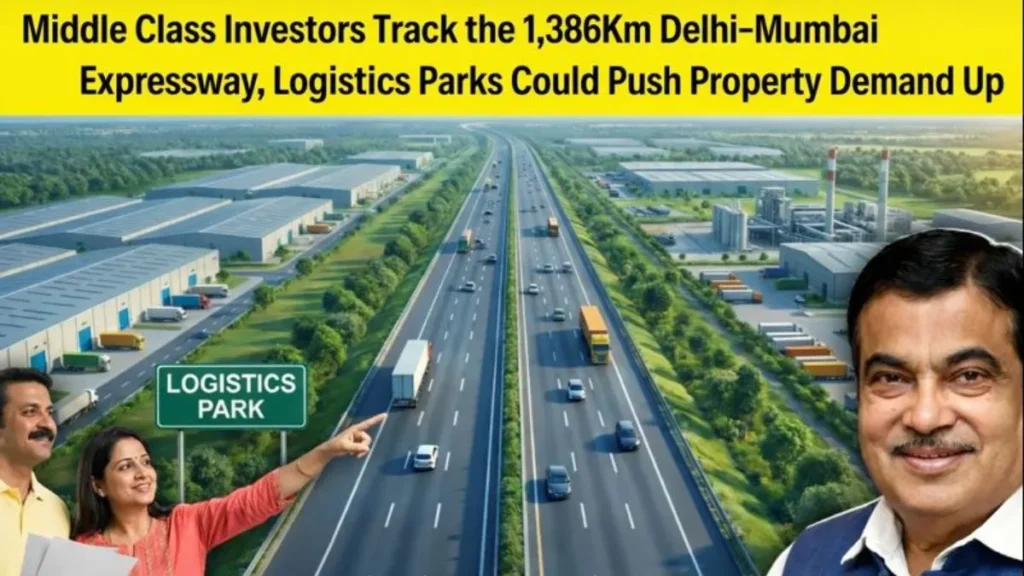
Middle Class Investors Track the 1,386Km Delhi–Mumbai Expressway Impact because this massive infrastructure project is shaping much more than travel convenience. Stretching across multiple states, the expressway is slowly becoming a powerful land and business corridor. As sections open and others move closer to completion, investors are watching how logistics parks, warehouses, and industrial activity may push property demand in nearby regions. For many middle class buyers, this expressway signals a long term opportunity rather than quick profit.
Design and Build Quality That Creates Business Zones, Not Just Roads
The Delhi–Mumbai Expressway is designed as an access controlled, high speed corridor passing through Delhi, Haryana, Rajasthan, Madhya Pradesh, Gujarat, and Maharashtra. For investors, the real value lies in interchanges and feeder roads. These points attract fuel stations, truck parking, food outlets, and logistics services. Wherever a well planned interchange comes up, land around it starts gaining attention. Quality construction and planned exits help businesses visualize stable operations, which slowly turns empty land into active commercial zones.
Also Read: Hero Splendor Hybrid 2026 Revealed..! 95Km/L Mileage Target, Smart Assist Technology, Price ₹92,000
Faster Travel Time Changing Logistics Planning on Ground
One major reason Middle Class Investors Track the 1,386Km Delhi–Mumbai Expressway Impact is the time saving factor. The travel time between Delhi and Mumbai is expected to reduce to around 12 to 14 hours. This predictable travel window helps logistics companies plan routes better. When transport becomes faster and reliable, warehouses and storage hubs shift closer to expressway exits. This directly increases demand for nearby plots, rental rooms for workers, and small commercial spaces.
Logistics Parks Becoming the Real Property Demand Engine
The expressway falls under the wider influence of the Delhi–Mumbai Industrial Corridor. This combination of industrial planning and fast connectivity is powerful. Logistics parks do not work alone. They bring jobs, truck movement, daily needs, and service demand. Over time, this creates need for housing, shops, and local rentals. Investors who understand this chain reaction focus less on hype and more on how real businesses are setting up near the corridor.
Risk Checks Every Middle Class Investor Must Do Before Buying
Opportunities are usually strongest within 0 to 3 kilometers of interchanges, but risks also exist. Poor approach roads, unclear land use, legal disputes, and aggressive dealer promises can trap buyers. Another risk is construction delay, which has happened in parts of the project. Smart investors regularly track official updates, check title clarity, and avoid buying only on social media claims.
Smart Price Strategy Focused on Stability, Not Noise
Property prices usually move in phases. The biggest gains often come after regular traffic and business activity starts, not at announcement stage. A safer approach is to think about lease potential such as warehouses, roadside shops, or rental housing. This creates steady income and reduces dependence on resale timing. That is why Middle Class Investors Track the 1,386Km Delhi–Mumbai Expressway Impact with patience and practical planning.
Also read :- Bank of Baroda 18 Month Fixed Deposit 2026 A Simple Way to Earn 7.90% Without Risk